 The Geek Circle The Voice of Africa’s Tech Community
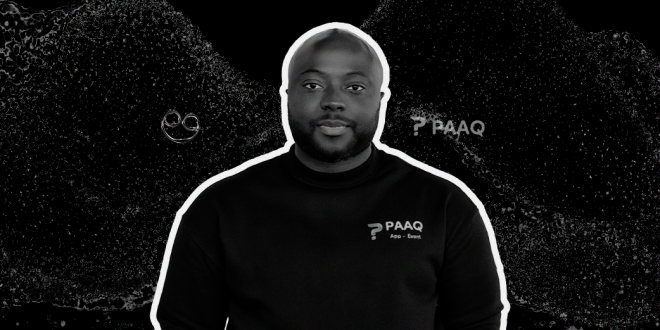
At some point in the middle of the night, Olusegun Adeleke was walking down the stairs toward his bedroom, trying to force himself to sleep after hours of restlessness, when a thought arrived that didn’t feel like his own.
It was the seed of PAAQ, which stands for Please Ask Any Question, a platform connecting knowledge seekers with verified experts across virtually any domain. Visualize a place where anyone could access the right person, in the right field, at the right time. That’s PAAQ.
Years later, that idea has become the foundation of a product Olusegun is still building with the same conviction he felt that sleepless night.
Falling in love with computers before the Internet
Olusegun grew up in Nigeria at a time when there was no internet, only computers. After school, he’d go to a relative’s training centre, where people learned how to use MS-DOS and design banners for schools and churches.
He’d show up before the classes started, curious about the machines. “I loved asking questions,” he says, “Can I type anything and then undo it? Can I make a mistake and then undo it?”
He got his first computer at 13. There was still no internet. But he spent his time pulling things apart, figuring out how they worked, and rebuilding. When the internet finally arrived, the realisation that there was something more hit him. It widened his sense of what was possible.
It was when a D in English kept him out of Obafemi Awolowo University that he decided to take computers even more seriously. Rather than wait, he went looking for something to do. He got a job and enrolled himself at APTECH to study C++, paying the fees out of his own salary without telling anyone. It was this sense of agency that would help him go far.
Before PAAQ, there were other ideas
By the time Olusegun started building PAAQ, he had already tried to build several things. He co-founded Banx Restaurant in South Africa, which offered home delivery long before the food delivery apps took hold. Increased demand for meals led him to get the bikes, brand them, and deliver food to homes. He toyed with the idea of an Uber-style logistics company back in 2012, but didn’t go through with it because he lacked the funds. He also built a property hub platform but never launched it.
None of those ventures became the thing he could see himself doing for a decade. He is clear about why that matters. “I think if you cannot see yourself doing something for ten years straight, don’t start it.” The others were interesting. But PAAQ felt different from the beginning.
He was already preparing to launch a different product when the sleepless night happened. Walking down the stairs, heading to force himself into bed, he heard what he describes as a voice from inside, an idea arriving fully formed and not quite his own. “Imagine two people. They could ask each other questions. The one who has the knowledge gives to the other who doesn’t have the knowledge.” He stopped. He started walking slowly, afraid that moving too fast would make the thought disappear. The idea kept coming, completing itself as he listened.
By the end of that same day, he had started mapping it out.
Building it was harder than hearing it
The idea may have arrived clearly, but turning it into a product was another matter. Olusegun sold a watch to pay his first developer. The early version of the app took about eight months to deliver. When it arrived, it wasn’t what he wanted. It was Android only, and the design didn’t meet his standards. He walked away from it, though he still has the app on his phone.
If he could go back, the thing he would change is not the product itself but his approach to building it. He wishes he had sought out a mentor earlier, joined a community like Y Combinator, or at least understood the ecosystem well enough to ask for help before the mistakes accumulated. “I made a lot of mistakes along the line, which have cost me a whole lot, cost me time, cost me money.” His instinct was always to trust himself, which he says can be a form of recklessness. It is easy, he notes, to jump into the pit when you think you have it all figured out.
Talent was also an ongoing challenge. Developers came and left, sometimes without warning. A designer left for a bigger offer. Another had a medical issue. At various points, Olusegun had to start over with new people who had no context for the decisions already made.
Olusegun continued undaunted. He taught himself Figma using YouTube tutorials. He would copy what one of his designers did, break it down at home, rebuild it, then go back with questions the next day. Eventually, the designer left for his medical appointment and did not come back, and Olusegun realised he did not need to replace him. He designed the entire PAAQ product himself, the app, the website, the social media content, all of it.
Creating a knowledge-sharing community through PAAQ
The platform’s premise is that access to the right expert, at the right time, is a problem almost everyone has, and almost no one has solved. Consultation platforms tend to be niche-specific. Freelance marketplaces like Fiverr and Upwork focus on services rather than knowledge exchange. PAAQ’s angle is different: the same person who needs advice today can be the expert someone else needs tomorrow. “Someone as an expert can also be a user,” Olusegun says.
The platform lets experts monetise their time while giving anyone, regardless of background, a path to the person who can actually help them.
PAAQ Events grew out of this same instinct. Olusegun was invited to an event and wanted to give something useful to the host, a well-known South African marketing figure. He built a simple QR code system on the spot that allowed attendees to submit questions digitally, removing the friction of microphones and raised hands.
Olusegun wasn’t trying to build a new product. “I didn’t even know there were things like Slido. So I wasn’t thinking about business,” he says. He was just solving a problem he had.
That product became PAAQ Events, an event productivity tool that serves organisers, sponsors, speakers, and attendees. Its most recent feature uses AI to match attendees who share professional interests, so the person you need to meet at a conference is not someone you have to find by walking every corner of the room.
Build for people, not users
Olusegun does not call the people on his platform users. He calls them customers, deliberately, as a reminder that they are people with emotions and situations that matter. Getting feedback from them is not a survey exercise. His team calls them on the phone. They ask why someone dropped off. They inquire why a feature went unused and what they actually needed. “When you now understand what they want, then you build a product for them.”
Creating for the customer in mind also guides every product decision. “Anything that you do must be so easy to use. I always ask whether a 65-year-old with no formal education can use this?” he says. If not, it is too complicated.” This is the standard he applies to his own work and the one he passes on to anyone who joins his team.
Olusegun wants only people who are customer-centric on his team. He does the interviews himself. (He has done over 500 of them since starting PAAQ!) What he is looking for is not just skill but care. Startups, he says, are not big corporations where people become abstractions. In the early stages, you need people who actually care about other people, because those are the ones who will ask the right questions and stay curious enough to grow.
For the bootstrapped founder, AI is an accelerant. He has taken to using Claude Code alongside Figma, prompting the tool to generate designs that appear directly in the design tool, which he then refines. It has compressed what used to take days into hours.
His view is that AI makes the building faster but does not replace the judgment required to know what to build. People will still look for the thought leader in a specific domain, the human who has genuinely lived and worked inside a problem. PAAQ, in his mind, is exactly that kind of platform.
Olusegun’s advice to African founders is to stop chasing shiny new things. Solve the problem you already experience every day. “That thing that you complain about, if you can solve it, you believe it will definitely not only solve the problem for you, but for everyone.” Validate it. Get a mentor. Join an accelerator if you can. Do the research before you fall in love with the solution.
Where PAAQ is headed next
Olusegun’s near-term focus is connecting PAAQ App and the PAAQ Events. He wants attending a conference to become the beginning of a relationship rather than the end of one. Attendees will be able to see other events, view speaker profiles, send questions, and receive AI-matched introductions to people who share their interests, all within a single profile. He also sees students as a future segment, a group that needs access to the right people both during their studies and after.
Through his work, he hopes to give people ease. “I just hope that the legacy I get to leave behind is that because of what I’ve done, life was easy for you.”