 The Geek Circle The Voice of Africa’s Tech Community
“There was no structured learning path. I had to learn backend engineering from different people.”
Solomon Eseme’s entry into backend engineering was not smooth or straightforward. In his own words, it was messy. He learned HTML, CSS, and JavaScript from different courses, different instructors, and different teaching styles. Each teacher had their own method, language, and assumptions. Instead of giving him clarity, the process often left him more confused.
For years, Eseme was trapped in what developers commonly call tutorial hell. He could follow along with a lesson and build what the instructor was building, but once the video ended and he faced a blank screen, he struggled to move forward on his own.
That experience cost him time he cannot get back. But it also became the foundation for everything he would later build.
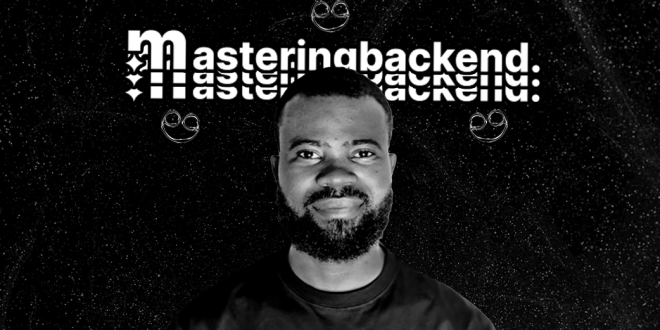
Today, Eseme runs Mastering Backend, a structured learning platform designed for backend engineers at every stage, from complete beginners to experienced developers looking to close specific skill gaps. Alongside the platform, he publishes a newsletter, hosts a podcast, leads an active developer community, and writes technical content that has helped thousands of people grow as software engineers.
But before Mastering Backend became a platform, a business, or a community, it began as one engineer’s attempt to create the learning path he wished he had.
Getting out of tutorial hell
Eseme remembers the frustration clearly. He could follow tutorials step by step and produce something that worked. But the knowledge did not feel like his.
“You have to rely on tutorials to be able to do something,” he says. “You do shallow learning. You don’t really have depth.”
His circumstances made the process even harder. At the time, he did not own a computer. He would write code in a notebook, then go to a cyber cafe and buy one hour of computer time just to type it out and test whether it worked.
The turning point came when he gave himself a single challenge: build a Windows calculator in Java from scratch.
It was difficult. He struggled through it. But he finished.
That project changed the way he approached learning. His questions became more practical, more focused, and more independent.
“My questions shifted from ‘what is this?’ and ‘what is that?’ to ‘how do I implement this?’ and ‘how do I make this work?’” he recalls.
Around the same period, Eseme also began to understand where his real interest lay. He had spent years working on the frontend, building layouts and recreating existing designs. But when he had to start from a blank canvas, without a visual reference to follow, the work drained him in a way backend engineering never did.
“If I’m given ten tasks in backend and one in frontend, I would finish the ten backend tasks before I finish the frontend one,” he says.
That made the answer clear. Backend was where he belonged.
Once Eseme found his footing as a builder, he turned his attention to the very problem he had just escaped. He began blogging about what he was learning, but he did not write random standalone posts. He created structured series that allowed readers to start at the beginning and follow a clear path to the end.
Most of the blogs he started during that time did not survive. One did.
It was called Mastering Backend.
At first, it was nothing more than a personal record of his own learning. There was no business plan, no grand strategy, and no platform behind it. Eseme simply wanted to give other developers the clear, sequential path that had never existed for him.
That small blog would not stay small for long.
Building a school for beginner, intermediate, and senior engineers
The first version of Mastering Backend was extremely simple.
“You just come in there, you read content, and then you go read. That was just what it was,” Eseme says.
The platform looks very different today.
Over time, Mastering Backend grew into a more deliberate learning system. It now includes structured learning paths, a gamified challenge system, project-based coursework, community channels, a newsletter, and a podcast.
That evolution came from Eseme’s understanding that people do not all learn the same way. He had seen this firsthand while working as a faculty member at a software engineering school, where he taught several programming languages to different kinds of learners.
Some students learn best by reading and absorbing concepts. Others need to be thrown into projects. Some are motivated by progressive challenges that feel like moving through levels in a game.
Mastering Backend was built to support all three through its Learn, Build, Grow model.
Students begin with structured courses and boot camps that walk them through backend fundamentals. From there, the focus shifts from simply learning syntax to developing real engineering judgment through practical work.
Eseme describes the project experience as similar to receiving a product requirements document at a real software company.
“We give you projects, and then we give you this PRD that contains everything you need to do: what your response should look like, how your request should look, everything. Then you follow along and build,” he says.
For more experienced engineers, Mastering Backend offers mock interview tools and an alumni community that helps them identify specific gaps and work on them intentionally.
The community around the platform also grew naturally. What started as a learning resource eventually expanded into a WhatsApp community where developers at different levels could connect, ask questions, and learn from one another.
The newsletter was a natural extension of Eseme’s work as a technical writer. The podcast came from the same instinct: a genuine curiosity about other people’s stories and a desire to bring those stories into a space where the wider developer community could benefit.
But turning Mastering Backend into a sustainable business was not easy.
Eseme tried adding AdSense to the website, but it disrupted the layout and brought in very little revenue. He tried affiliate marketing, but that did not work either.
“The business part is the most difficult, the hardest of it all,” he says. “You cannot say you’ve found market fit forever. You always have to be progressive.”
He kept testing, adjusting, and learning until he found a model that worked.
So far, Mastering Backend has reached more than one million developers, with users completing over 170,000 hours of practice.
Even with that growth, Eseme is not done building. As he has taken on more complex engineering work, including his own AI-powered products, Mastering Backend has evolved with him. The platform now includes courses on production-grade AI backend systems, not because AI is a trend to chase, but because Eseme believes it is part of where serious backend engineering is heading.
Engineers who communicate lead
When most developers think about career growth, they think about technical depth. Build more. Ship more. Learn more frameworks. Write better code.
Eseme agrees that technical ability matters, but he believes it is only part of the story.
After years of watching engineering careers up close, he is convinced that the thing that separates good developers from great ones is communication.
“The best engineers are not just those who can write code,” he says. “The best engineers are those who know how to communicate.”
In Eseme’s view, many engineers can write code, but far fewer can explain what they are doing to the people around them. That gap can become a career ceiling.
The developer who can explain a technical decision to a non-technical stakeholder becomes more than just another person on the engineering team. They become the person people rely on when things need to be understood, clarified, or translated.
“It makes you the number one go-to person,” Eseme says. “If you can write, that means you can explain it. That makes you the go-to person in your team when it comes to breaking down tasks and breaking down technical jargon.”
Writing is where Eseme has seen this most clearly in his own career.
He started writing technical content in 2017, initially as a way to document what he was learning. Over time, he realised that writing had changed the way he thought about engineering itself.
To write clearly about a concept, you have to understand it deeply. It is not enough to know that something works. You have to know why it works, how to explain it, and where someone else might get confused.
Teaching sharpens thinking in ways that building alone often does not.
The career implications are real. The engineers who rise into roles of influence are not always the deepest coders in the room. Often, they are the ones who can connect technical work to business needs, explain trade-offs, document decisions, and help other people move faster.
“If you are working as an engineer and you know how to write, it makes you the go-to resource person,” Eseme says. “You are definitely aiming to become a tech lead.”
His advice to early-career engineers is not to choose between technical skill and communication. It is to treat both as non-negotiable.
AI is backend engineering with a new chapter
What many people now call AI engineering is, in Eseme’s view, backend engineering with a new layer added to it.
The infrastructure underneath is still backend infrastructure. The fundamentals are still the fundamentals. Strip away the AI integrations, and what remains is a backend system that either works or does not.
And whether it works depends on how well it was built.
Eseme learned this through experience. When he worked on his first AI project, things began to fall apart quickly.
“We were treating the AI system as a separate entity,” he says.
The team had focused heavily on the AI layer while underestimating the infrastructure needed to support it. Without a solid, scalable backend underneath, the AI integrations had nothing reliable to stand on. Every weakness in the base system eventually showed up as a failure at the surface.
That experience directly shaped how Mastering Backend now teaches AI development.
The platform’s AI backend boot camp runs for six weeks. For the first three weeks, students do not touch anything directly related to AI. The focus is pure backend engineering: the foundational work required to make any serious system stable, scalable, and reliable.
“You won’t see anything relating to AI for probably three weeks,” Eseme says. “We are going to teach you the base infrastructure that your AI system is going to rely on.”
His broader point is simple: there is no shortcut around the fundamentals.
AI has not changed that. If anything, it has made the fundamentals more important. When the foundation is weak, the cost shows up quickly, whether that cost is technical, financial, or reputational.
The next step for technical talent in Nigeria and beyond
Nigeria has no shortage of people who call themselves software engineers. What it does have, in Eseme’s view, is a shortage of engineers who can consistently deliver when it matters.
“There is this belief that we lack skill,” he says, speaking about the local tech ecosystem. “We have a lot of people who are software engineers and stuff, but when you give them the job, they will not be able to deliver.”
Changing that narrative is the specific, concrete mission he wants Mastering Backend to stand for.
For Eseme, the goal is not just to help people complete courses or collect certificates. It is to help them become engineers who can build real production systems, communicate clearly, and contribute meaningfully inside a team.
He wants every engineer who passes through Mastering Backend to leave with two things: the technical ability to build systems that work in the real world, and the communication skills to explain, defend, and improve those systems with others.
That mission comes directly from his own journey.
Eseme knows what it feels like to learn without structure, to depend on scattered tutorials, to lack the tools and guidance needed to grow with confidence. Mastering Backend is his answer to that experience.
It is not just a platform for learning backend engineering.
It is the path he wishes someone had built for him.