 The Geek Circle The Voice of Africa’s Tech Community


After helping companies define where they wanted to go, the consultant found himself confronting a harder question about what happened next. Rople is his attempt to connect those ambitions to the work people do every day.
The strategy had been written. The goals had been agreed. A few months later, the working day still looked too much like the one before.
Chinaza Victor Ugwu remembers encountering that gap while consulting for a real estate company in Lagos. The business wanted to grow. There had been sessions to work through its direction, retreats and discussions about the targets that mattered. Ask people whether those priorities were important, he recalls, and they would say yes.
Their daily work told a different story.
The problem, as Victor came to understand it, was that the company struggled to follow its strategy through to execution. Spreadsheets offered pieces of the picture, but it was difficult to see which activities were moving the business towards its goals and which were simply filling the day.
“How do you now translate that into daily actions?” he asks.
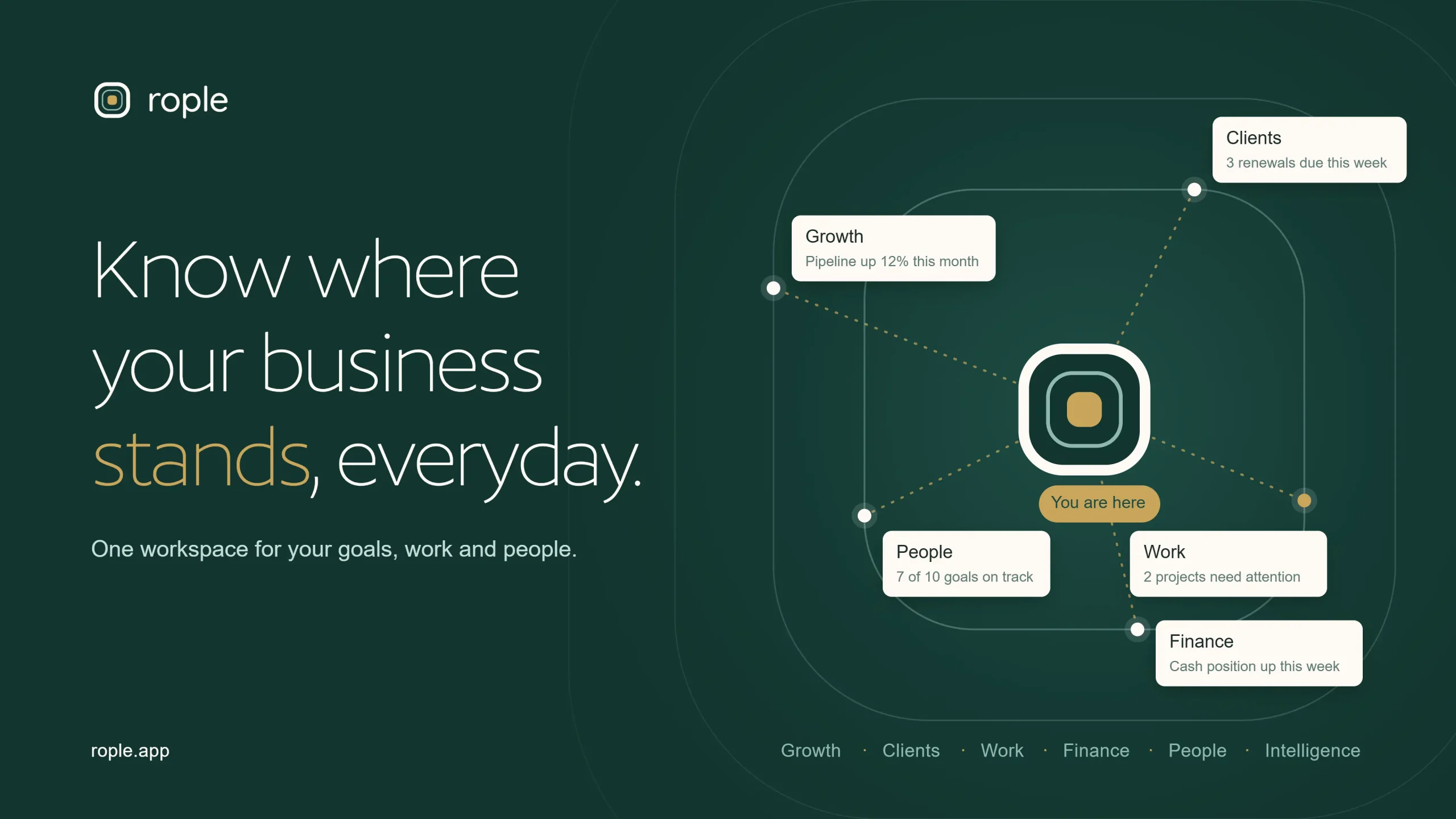
That question sits at the centre of Rople, the startup he leads as founder and Lead Innovator. The workspace brings goals, customer records, projects and people together, with the aim of helping businesses understand what their work is producing while there is still time to do something about it.
For Victor, it is a question that reaches back well before he started building software.
A long interest in how businesses work
Growing up, Victor was fascinated by how a business could start small and become something much larger. He wanted to understand how companies operated, how they made money and what allowed them to grow.
At university, he tried starting businesses of his own. The more he thought about running them, the more his attention shifted to the people involved. A business needed people to work, and understanding the business meant understanding their behaviour too. He began studying psychology, which remains one of his favourite subjects.
Consulting gave those interests somewhere to meet. In one of his early jobs after university, he worked with companies on strategy and growth. He became convinced that a clear direction mattered. He read widely, including the work of business author Jim Collins, looking for ways to understand what made organisations succeed.
When he later began working independently, he carried those lessons with him. But knowing how to help a company articulate its ambition left him with an increasingly persistent concern: what happened after the strategy sessions ended?
The Lagos real estate assignment made that concern difficult to ignore. Victor could help a team decide what it wanted to achieve. He also needed a way for people to see how their work related to that decision on an ordinary working day.
The first version created another job
Rople began inside Victor’s growth and innovation consultancy. Its earliest testers included businesses the consultancy already worked with, giving the team a chance to put the product in front of people whose operational problems they knew.
The first version focused on performance management. Victor wanted employees to make their contributions visible and have their work recognised. An early customer tried it free for roughly a month or two, returning to record goals and progress.
Watching that use exposed a flaw.
A salesperson could make calls, follow up leads and close deals elsewhere, then have to open Rople to describe what had happened. The tool intended to make work clearer had introduced another reporting obligation.
“People needed to be able to do work inside,” Victor says.
That observation changed the product. Rople began expanding into the place where customers could manage the work itself. A salesperson could record a conversation against a lead, and that same record could support an update on progress. There would be less need to reconstruct the week for a separate review system.
Victor does not romanticise the early experience. He remembers rough interfaces and lag. What encouraged him was that people continued to try it and could see enough value to ask for something better.
What happened after the call
To explain the difference he wants Rople to make, Victor returns to a sales example. A team can be instructed to call 50 leads a day, meet that target and still finish the week without a sale.
The calls happened. The result the business needed did not.
That does not automatically mean the salesperson failed. Perhaps the leads were unsuitable. Perhaps the offer needed work. Perhaps a promising conversation required a follow-up nobody had recorded. Counting calls alone cannot explain which of those things happened.
In Victor’s description of Rople, the record includes the outcome of the conversation and the next action. A colleague or manager can see what the prospect said and what needs to happen next. The business has something more useful to work with than a total at the end of the day.
The same thinking shapes how goals connect to projects and tasks. Victor says the product links those records so that progress against a defined target can be reflected as work is recorded. A manager should be able to trace a number back to the work behind it. An employee should be able to understand why a task matters.
He describes a view called “your business day”, intended to show leaders what people are working on, the approvals they need to make and what has moved. For the person doing the work, the priority is a clearer view of their own responsibilities.
These are related needs, but they are not identical. A founder wants to understand the whole business. An employee needs to know what deserves attention now.
The first customers helped choose the direction
Asked about the hardest part of building Rople, Victor answers without hesitation: getting the first two paying customers.
The product was still incomplete. He had to find businesses willing to pay for what it could become while the team was still working out what they needed. The second customer asked for custom views, helping push Rople towards a more adaptable workspace.
Both early customers were in real estate. Their needs gave the team a concrete place to focus, shaping workflows and features for the sector. Victor points to the way different firms manage their relationships with independent realtors. One may call it a partner network, another a realtor database, even where the underlying process is similar.
His approach is to understand the customer’s workflow, explain what Rople already supports and then identify where adaptation is necessary. Sometimes the terminology needs to change. Sometimes the process itself needs a custom build.
That work has also taught him that a convincing demo does not settle the adoption problem. People still have to learn the tool and make it part of their routine.
For one customer, the team ran performance management training before introducing everyone to the software. They worked through how to set goals and organise tasks, giving the product a context the users could understand. Victor describes supporting customers through a learning period of around three months and plans for an academy with instructional videos.
His consulting background is visible in that approach. The work includes helping customers organise their processes as well as giving them software to use.
Making work visible without losing its context
Visibility becomes more complicated when the records help determine how an employee is assessed.
A missed deadline can reflect poor planning, but it can also reflect an approval that never arrived or work another team could not finish. Important contributions do not always fit neatly into a count of completed tasks.
Victor says Rople’s approach leaves the final judgement with people. Managers and peers contribute to reviews, bringing context that the records alone cannot supply.
“No decision is made by Rople,” he says.
He wants the information to support a conversation about what happened, what blocked the work and what could improve. If a task is stuck today, the team should be able to address it today, rather than wait for an annual review to explain the missed target.
That emphasis also appears in a feature he said the team was preparing to release on the day of the interview. When an issue was resolved, the proposed workflow would prompt the team to capture the lesson and consider whether a procedure needed updating. Over time, those records could give colleagues somewhere to look when a familiar problem returned.
The broader ambition is to help an organisation retain what it learns while doing the work.
Building with a small base of users
Rople remains early in its development. Speaking to The Geek Circle on October 6, 2026, Victor said roughly 15 organisations had tried a demo at some point. He reported three active organisations and approximately 115 registered team members, around 40 of whom were active users. He did not specify the period used to measure activity.
Those are founder-reported figures, and they describe a small customer base. They also show where the company’s work now sits: learning from use, improving the product and finding more businesses willing to adopt it.
Victor says he has funded most of the journey personally. The team uses AI tools extensively in development, alongside product design support and human testing and review. He is enthusiastic about what that makes possible, while recognising that customer feedback has changed the product in ways the initial idea did not anticipate.
He also acknowledges an uncomfortable detail from the early period. Even while developing Rople, his own organisation was still using Notion. Moving its work into Rople helped him see more clearly how the product could serve other teams.
A reason to keep going
When Victor talks about where he wants Rople to go, the conversation returns to people.
He plays chess, and he is interested in what a visible rating does to motivation. A player can see the distance between where they are and the level they want to reach. Improvement becomes easier to follow, even when the larger goal remains some way off.
He wants working towards a business goal to have some of that clarity. Employees should be able to see what their effort contributes and how progress relates to recognition or a reward. The goal should remain present after the meeting in which it was announced.
Rople still has to prove that it can deliver that experience consistently as more organisations use it. But Victor’s idea of success is rooted in the frustration that started the company: people can agree on a direction and then lose sight of it in the working day.
He wants the next strategy review to begin with a record of how the team moved towards its goal, and enough understanding of what happened to decide what comes next.