 The Geek Circle The Voice of Africa’s Tech Community


A missed call home or an unanswered message rarely carries a work deadline’s urgency. From Abuja, the software engineer behind Nudge is building an assistant that keeps those smaller commitments in view.
Favour Agozie was getting his work done. That was part of the problem.
Client deadlines had consequences he could see immediately. A task needed to be finished by Friday because someone was waiting for it, and because the work paid the bills. The things he kept putting off were often more personal: calling his mother after a trip, replying to a cousin, following through on something he had said he would do.
A message would arrive while he was busy. He would make a mental note to deal with it later.
“But then later never comes,” he said.
No single forgotten commitment led him to build Nudge. It was the repetition. Each omission could seem small on its own, yet together they affected relationships he wanted to maintain. He needed a way to remember things at a time when he could actually act on them.
Nudge, the flagship product of his company Littleworks Technologies Limited, grew out of that need. Built from Abuja, it combines reminders with an AI assistant that can help plan when to send them, respond to changes and follow up when something remains unfinished.
The starting point was a question about his own life: what would help him stop losing track of the things that mattered outside work?
Before software there was the urge to invent
As a child, Favour wanted to be an inventor. His mother bought him technology, and he wanted to know how it worked. Games prompted another question: could he make something like that himself?
Software eventually gave him a way to turn those questions into things people could use. By the time of our interview, he had spent about seven years building across companies of different sizes, sometimes as the sole engineer on a project and sometimes as part of a larger team.
He describes himself as “an ambitious builder”. Away from work, he goes to the gym, plays games occasionally and spends time with a close circle of friends from school, work and elsewhere. Those friendships are how he switches off. They are also part of the life he was trying to make more room for.
He began working on Nudge during a December visit to his village for the holidays. Away from his usual friends and activities, he had time to tackle a problem that seemed to grow each year as he got busier.
The first version was more mechanical than the product he describes today. Its central idea was persistence: keep bringing a task back into view so that dismissing a notification did not become the end of the matter.
He gave it to a friend who was also a software engineer and founder. The friend returned with an encouraging report: the reminders had kept coming until he got things done. His brother tried it too, using it to keep longer-term commitments from drifting out of mind.
For Favour, those early responses suggested that a tool built around his own habits could help other people. They also opened a harder question. How much persistence would each person welcome?
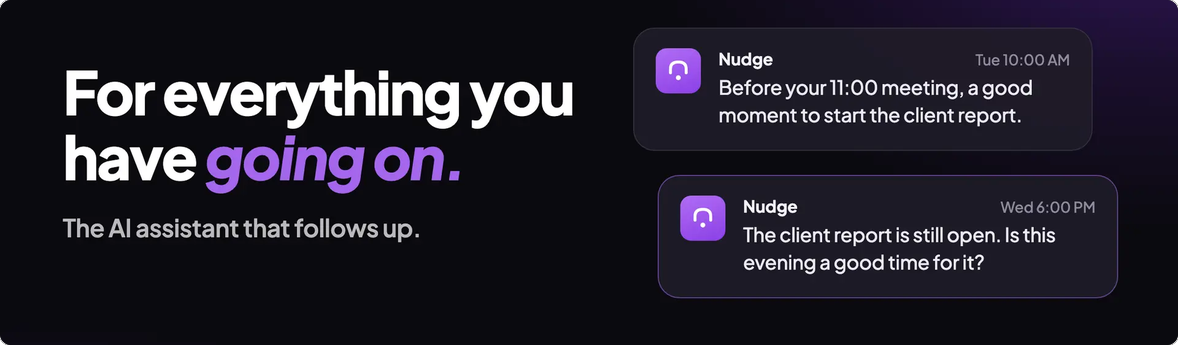
A reminder that can take an answer
To explain Nudge, Favour describes a freelancer with client work and errands competing for attention. There is an invoice to send by Thursday, dry cleaning to collect and money to send home. Some tasks have deadlines; others are simply things that need doing.
A user can tell Nudge about them in ordinary language. Favour says the assistant considers the task, the timing and the information the person has shared about their day. With Pro’s calendar connection, it can also take scheduled commitments into account.
The difference he is pursuing becomes clearer when the reminder arrives at an inconvenient moment. The user can postpone it, mark it complete or reply with an instruction such as asking to be reminded that evening. The aim is to make changing a plan feel as straightforward as explaining the change.
Favour often puts several things into Nudge at once, then adds smaller items as they arise. He is not always assigning a deadline. Sometimes he simply wants a thought to remain visible long enough for him to act on it.
Other people prefer a predictable routine: waking up, going to the gym, taking a break, praying or going to bed. Some want to manage tasks manually and have little interest in chatting with an assistant.
Accommodating those differences has been one of the hardest parts of building the product. A reminder that feels useful to one person can feel intrusive to another. Nudge offers different levels of reminder intensity, including a silent option for tasks a person wants to keep track of without automatic follow-ups.
Favour also wants the assistant to recognise when a task’s circumstances have changed. A missed meeting cannot be handled in the same way as an errand that can still happen tomorrow. Sometimes the useful next step is to ask whether something is still needed.
None of that means Nudge knows everything happening in someone’s life. Favour acknowledges that it works with the information it receives. If a trip, illness or change of plan never reaches the calendar, the user needs to tell it.
The intelligence only matters if the reminder arrives
Nudge runs on iPhone, Android and the web. Making the experience consistent across those platforms has involved work that a user may never notice unless it fails.
Saving an alarm time is only part of the job. Permissions, operating-system versions and the way a phone handles apps in the background can affect whether it rings. Favour says testing has had to extend well beyond the device he used for the earliest version.
“If the reminder itself doesn’t reach you,” he said, “the rest of the intelligence doesn’t help.”
He says low-end Android phones are part of the testing standard. With a little over half of Nudge’s users in Nigeria at the time of the interview, building around a narrow range of expensive devices would miss people already using the product.
There is also a distinction between basic task management and the online assistant. According to Favour, users can manually add, edit, complete and delete tasks offline, with changes synchronised when they reconnect. Alarms already scheduled on a phone can also work without data. Chatting or having a voice conversation with the AI requires an internet connection.
Availability still depends on the device and feature. Nudge’s website specifies that iPhone alarms require iOS 26 or later; browser users can view and edit alarms, but the alarms ring on a phone.
Letting people see what the assistant did
An assistant can misunderstand a request. Favour describes the balance between making helpful decisions and asking the user to confirm as an ongoing design concern.
During a voice conversation with Nudge, he says, actions appear on screen as they happen. Afterwards, the chat contains a record of the changes, alongside a transcript and summary. A user can review what the assistant did and correct it.
The product also lets people inspect, edit or delete the memories it saves about them. Those memories are separate from conversation history.
That control matters for a tool people may use to record family obligations, private plans and personal routines. Nudge’s published privacy policy explains that relevant content is sent to outside AI providers to process requests. It says that content is not used to train their models under the applicable API terms, while also noting that providers may retain data for limited periods. Using the assistant involves sharing information, and the policy makes that distinction explicit.
Finding users who have never heard of him
Nudge is still early. In our interview on 5 November 2026, Favour reported a few hundred sign-ups over the preceding months, with users across 37 countries. A little over half were in Nigeria.
He said the company began actively marketing in October, when sign-ups were almost three times September’s total. These are founder-reported figures, rather than independently audited measures, and they do not establish how many people use the product regularly.
That last question occupies him. He is looking at whether people keep creating and completing tasks after the first week, alongside what they say about the experience. But an app designed to work quietly in the background presents a measurement problem: someone may receive useful reminders for days without opening it.
A friend’s description of Nudge as useful for the little things meant a great deal to him because it matched the reason he had started. He also describes feedback from people who found it easier to establish routines and adjust them when plans changed.
Many early users came through his own circle. Beyond Nigeria, he says people have found Nudge through search engines, app stores and AI assistants, then recommended it to friends.
Those users have no personal reason to support him. The product has to explain itself and earn a place in their day.
Keeping the core useful and free
Littleworks builds and manages Nudge, which Favour says receives almost all the company’s attention. Other projects include UsageOS and YarnScribe, but Nudge is the main focus.
At the time of the interview, the company was bootstrapped and had taken no outside funding, he said. He described startup-programme benefits as one way of reducing operating costs, alongside assigning simpler AI tasks to smaller, cheaper models.
His decision to keep the core reminders free creates a commercial balancing act. The free product has to do enough to be worth keeping, while Pro needs to offer something people will pay for.
The published plans place tasks, routines and automatic follow-ups in the free tier. Pro adds capabilities including calendar integration, photo capture and conversational voice. Favour says regional pricing matters; Nigerian users can pay in naira through the web.
He wants Nudge to grow into an assistant that can do more of the work, with the user’s permission. He is also interested in exploring uses for businesses and schools, such as following up on meeting commitments or helping students manage assignments. Those are directions he wants to develop, rather than established business lines.
His ambition for everyday use is more immediate.
“You shouldn’t have to organise everything perfectly before Nudge can help,” he said.
That is a useful way to understand what he is building. The person who needs Nudge may already know what matters. They may even have written it down. What they need is another chance to act when the first reminder arrives at the wrong time.
For Favour, success could look like a call finally made to his mother after her trip, before another busy day turns it into something he meant to do.
Explore Nudge at https://usenudge.ai/.